The connection
How stress drives Skin and Hair Conditions
Telogen effluvium — stress-triggered hair shedding — typically manifests 3-4 months after a major stressor. Skin conditions including acne, eczema, and psoriasis all have confirmed stress-exacerbation mechanisms.
Source: Arck et al., Journal of Investigative Dermatology, 2006
Your body's stress map
Which systems are affected
Skin and Hair Conditions stress typically affects these body systems. Your Stress Fingerprint™ tells you exactly which ones are elevated in you.
How Stress Reaches Your Skin
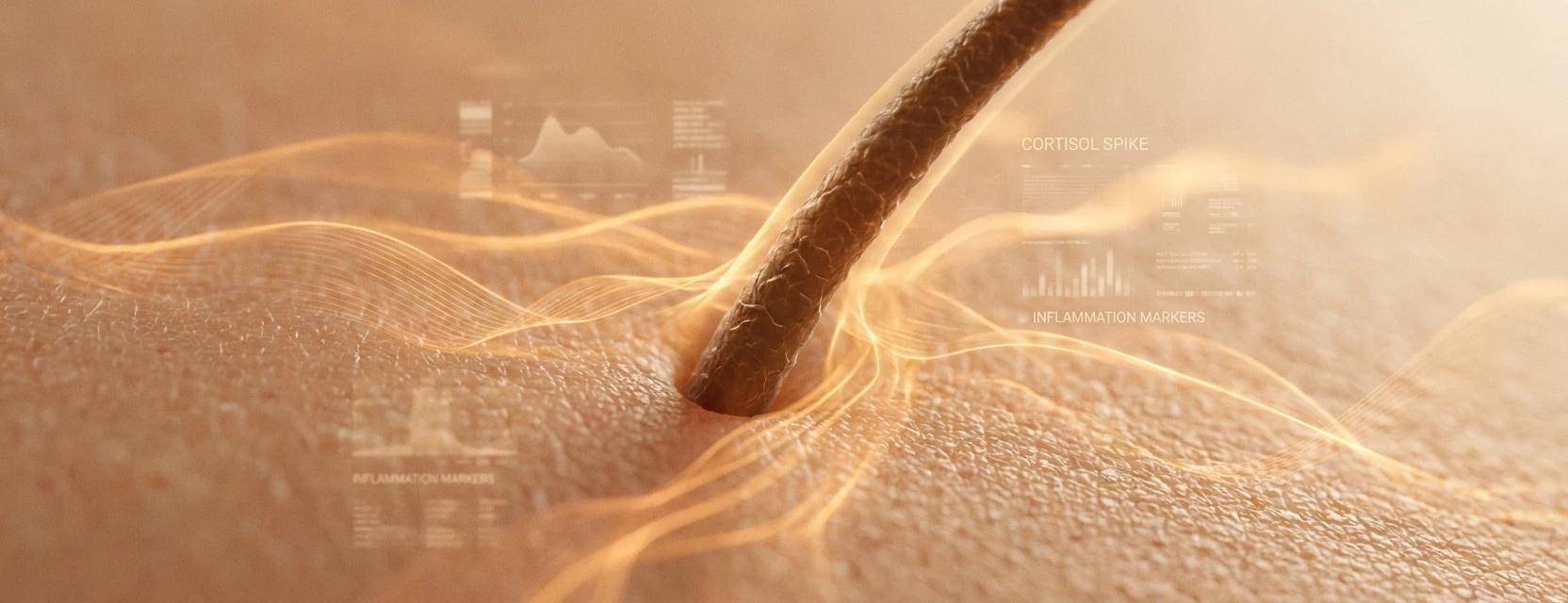
The skin has its own stress-response system — the cutaneous HPA axis. Cortisol increases skin oiliness driving acne, activates mast cells triggering hives and eczema flares, degrades skin collagen, and impairs the skin barrier. Stressed individuals heal cuts 40% slower. Telogen effluvium (stress hair shedding) typically appears 3-4 months after the triggering stressor — often confusing people who no longer recall the original event.
Signs to Watch
- Acne flares that correlate with stressful periods
- Eczema, hives, or psoriasis worsening under pressure
- Increased hair shedding 3-4 months after a major stressor
- Dull dry skin despite adequate hydration
- Slower healing of cuts or skin irritation
Is Skin and Hair Conditions connected to your stress pattern?
The Stress Fingerprint™ maps exactly where stress lives in your body — across 6 systems including the ones linked to skin and hair conditions. Free, 7 minutes.
Take My Free Assessment →42 clinically-framed questions · No login · Results in 7 minutes
Explore more
Related conditions
Not medical advice. This page is for educational purposes only. The connection between stress and skin and hair conditions is supported by research, but this is not a clinical diagnosis. Please consult a registered healthcare professional for medical advice.