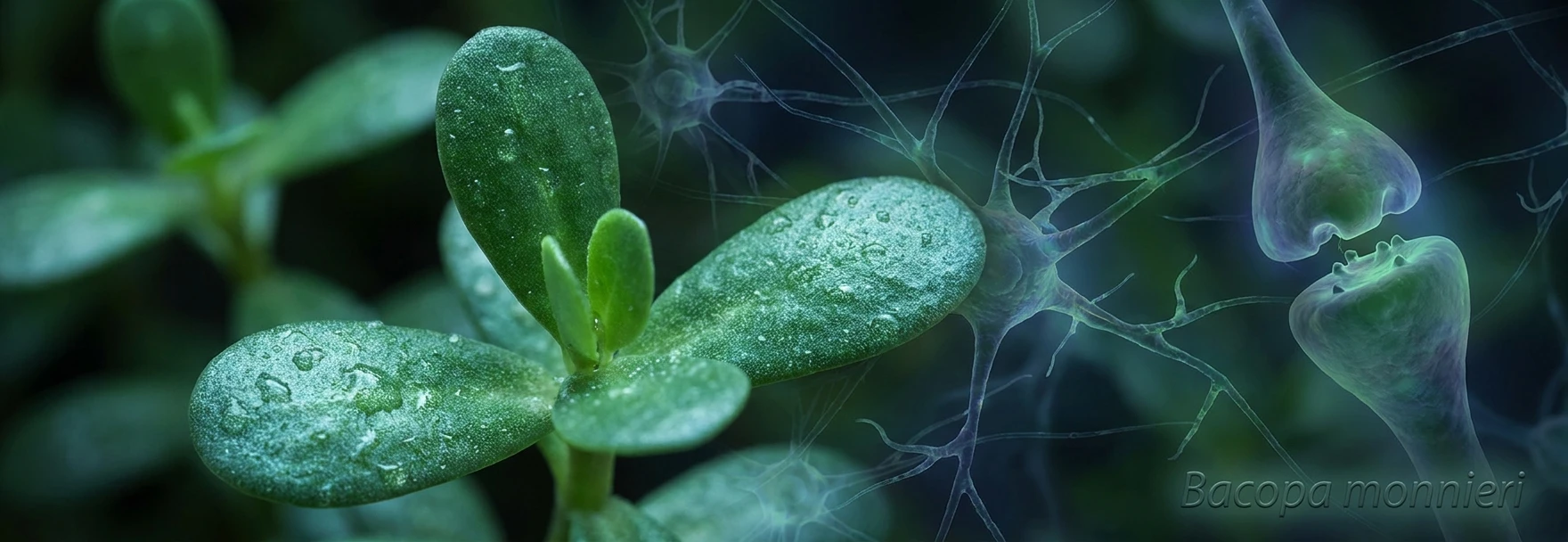
Used since the 6th century BCE for memory and clarity. Modern RCTs now confirm what Ayurvedic physicians observed: Brahmi modulates the cognitive effects of stress — reducing anxiety, improving memory consolidation, and protecting the hippocampus under cortisol load.
Stough et al (2001, Psychopharmacology) — 12-week double-blind RCT. Brahmi significantly improved spatial working memory and information processing speed vs placebo. Effect persists after stress exposure.
Calabrese et al (2008) — 12-week RCT in older adults. State anxiety (STAI) significantly reduced. Mechanism: inhibits acetylcholinesterase (memory enzyme) and modulates serotonin uptake.
Morgan & Stevens (2010) — cognitive function improved across attention, processing speed, and visual retention. Relevant for exam stress and work-stress cognitive decline.
Preclinical evidence: bacosides in Brahmi appear to protect hippocampal cells from oxidative stress damage. Cortisol causes hippocampal shrinkage — Brahmi may be partially protective.
2 RCTs in Indian children — improved attention, reduced hyperactivity vs placebo. The mechanism overlaps with stress-driven attention dysregulation (cortisol → dopamine → prefrontal function).
Serotonin modulation may support subclinical depression associated with chronic stress. Not a replacement for clinical depression treatment — adjunct evidence only.
Educational information only. Not medical advice. Consult a qualified practitioner.
Brahmi works best for cognitive-dominant stress: brain fog, memory under pressure, anxiety with mental over-stimulation. The Stress Fingerprint tells you whether your cognitive system is primary.
Find My Pattern — Free →