"Stress is just in your head. It'll pass. Just relax." That's The Lie. Stress leaves fingerprints in the body — measurable, mappable, addressable.
Find yours →Check what's true for you right now. This isn't a diagnosis — it's recognition.
The more boxes you checked, the more your stress system is communicating through your diabetes and blood sugar.
Find your exact stress pattern →"Cortisol is a direct glucocorticoid. Every stress episode is a blood sugar spike. In India's high-stress, sleep-deprived population, this is a largely invisible epidemic driver."
— Anagnostis et al., European Journal of Endocrinology
Your body is not failing you.
It is signalling you.
The connection between diabetes and blood sugar and chronic stress is not a coincidence — it is a biological signal your body has been sending, often for years. The Stress Fingerprint™ is how you learn to read it.
Diabetes and Blood Sugar stress doesn't stay in one place. Your Stress Fingerprint™ maps exactly which of these systems is carrying the highest load — and in what order they broke down.
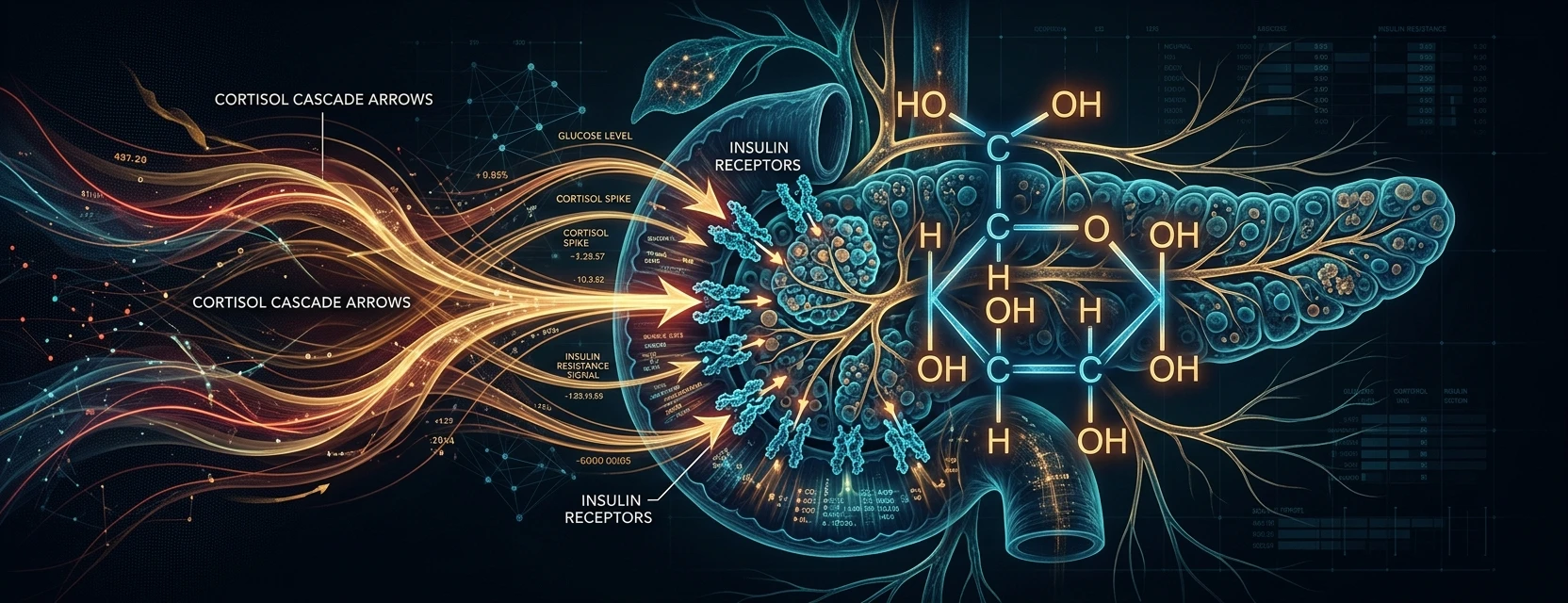
Cortisol directly raises blood glucose by stimulating hepatic gluconeogenesis. Chronic elevation creates persistent insulin resistance — the core mechanism of T2D.
Cortisol antagonises insulin receptor signalling. Even with normal insulin production, uptake is blocked — creating metabolic dysfunction without classic risk factors.
Every hour of lost sleep raises cortisol by 37% and impairs glucose tolerance measurably. Sleep debt and diabetes share the same upstream pathway.
Gut dysbiosis from stress impairs short-chain fatty acid production — critical for insulin sensitivity and pancreatic beta-cell health.
Stress-induced prefrontal suppression drives cortisol-spiking habits: late-night eating, high-glycaemic comfort foods, physical inactivity.
Insulin resistance and cortisol elevation share identical cardiovascular consequences — this is why diabetics have 4× the cardiac risk.
The cortisol-glucose connection is one of the most direct in stress biology. Cortisol is a glucocorticoid — it literally raises blood glucose. When stress is chronic, this means persistently elevated blood sugar, persistent insulin secretion, and eventual insulin receptor desensitisation. In India's context — where high-carbohydrate diets, sedentary lifestyles, and extreme work stress converge — this mechanism runs silently for years before T2D is diagnosed.
The Fingerprint maps all 6 body systems simultaneously. If diabetes and blood sugar is in your picture, it will appear in your dominant systems — and you'll see exactly which pattern it's forming.
The research is specific to India — and the numbers are harder to ignore than you might expect.
Recovery is not an event — it is a direction. The Stress Fingerprint™ maps where you are today and shows you the next step.
Start your recovery journey today
Map your stress pattern — free, 3 minutes. Your results connect diabetes and blood sugar to the body system carrying the load.
The Stress Fingerprint™ maps all 6 body systems in 3 minutes — free, no login. See exactly where your stress lives and which of 8 patterns it's forming.
Take My Free Stress Fingerprint™ →3 minutes · 18 questions · No login · Free forever
💛 The Care Loop
Share this with them. You’re not sharing a link — you’re giving them a mirror. The Stress Fingerprint™ is free, 2 minutes, no login.
Stress rarely affects one system alone.
Not medical advice. This page provides educational information about the connection between chronic stress and diabetes and blood sugar, based on peer-reviewed research. It is not a substitute for clinical diagnosis or treatment. Please consult a qualified healthcare professional for personal medical guidance.
Retake your Stress Fingerprint™ in 4 weeks to track how your body is responding to recovery.