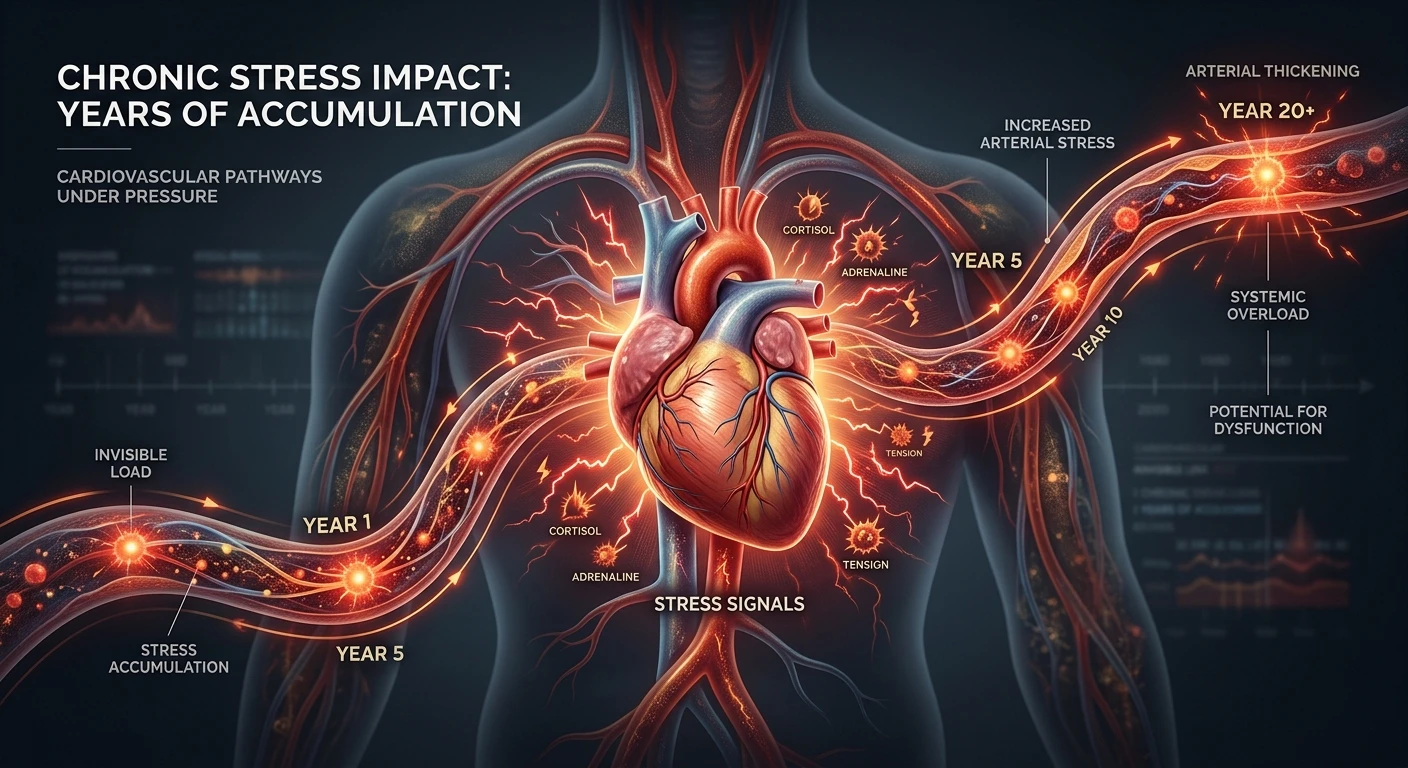
"Stress is just in your head. It'll pass. Just relax." That's The Lie. Stress leaves fingerprints in the body — measurable, mappable, addressable.
Find yours →Check what's true for you right now. This isn't a diagnosis — it's recognition.
The more boxes you checked, the more your stress system is communicating through your heart disease.
Find your exact stress pattern →"The association between psychological stress and cardiovascular events is as strong as that of smoking — and far less discussed in clinical settings in India."
— Yusuf et al., INTERHEART Study, Lancet 2004 (52 countries, 30,000 participants)
Your body is not failing you.
It is signalling you.
The connection between heart disease and chronic stress is not a coincidence — it is a biological signal your body has been sending, often for years. The Stress Fingerprint™ is how you learn to read it.
Heart Disease stress doesn't stay in one place. Your Stress Fingerprint™ maps exactly which of these systems is carrying the highest load — and in what order they broke down.
Cortisol and adrenaline elevate heart rate, constrict arteries, and raise blood pressure. Chronic activation causes endothelial damage — the first stage of atherosclerosis.
The brain-heart axis is bidirectional. Rumination, anxiety, and chronic worry maintain cortisol peaks that compound cardiac load across 24 hours.
Poor sleep from stress raises nocturnal blood pressure by 15–20mmHg. Non-dipping BP pattern is an independent predictor of cardiac events.
Stress triggers IL-6 and CRP elevation — markers of systemic inflammation that directly accelerate plaque formation and clot risk.
Cortisol raises LDL cholesterol, lowers HDL, and promotes visceral fat deposition — all established cardiac risk factors.
Chronic stress suppresses regulatory T-cells while activating inflammatory pathways — increasing arterial plaque vulnerability and rupture risk.
The INTERHEART study — spanning 52 countries and 30,000 participants — found that psychosocial stress accounted for 32% of all heart attack risk globally. In South Asia, this figure was higher. The mechanism is clear: chronic cortisol elevation leads to endothelial inflammation, platelet aggregation, arterial stiffening, and LDL oxidation — all simultaneously. Stress is not a soft risk factor. It is a molecular one.
The Fingerprint maps all 6 body systems simultaneously. If heart disease is in your picture, it will appear in your dominant systems — and you'll see exactly which pattern it's forming.
The research is specific to India — and the numbers are harder to ignore than you might expect.
Recovery is not an event — it is a direction. The Stress Fingerprint™ maps where you are today and shows you the next step.
Start your recovery journey today
Map your stress pattern — free, 3 minutes. Your results connect heart disease to the body system carrying the load.
The Stress Fingerprint™ maps all 6 body systems in 3 minutes — free, no login. See exactly where your stress lives and which of 8 patterns it's forming.
Take My Free Stress Fingerprint™ →3 minutes · 18 questions · No login · Free forever
💛 The Care Loop
Share this with them. You’re not sharing a link — you’re giving them a mirror. The Stress Fingerprint™ is free, 2 minutes, no login.
Stress rarely affects one system alone.
Not medical advice. This page provides educational information about the connection between chronic stress and heart disease, based on peer-reviewed research. It is not a substitute for clinical diagnosis or treatment. Please consult a qualified healthcare professional for personal medical guidance.
Retake your Stress Fingerprint™ in 4 weeks to track how your body is responding to recovery.