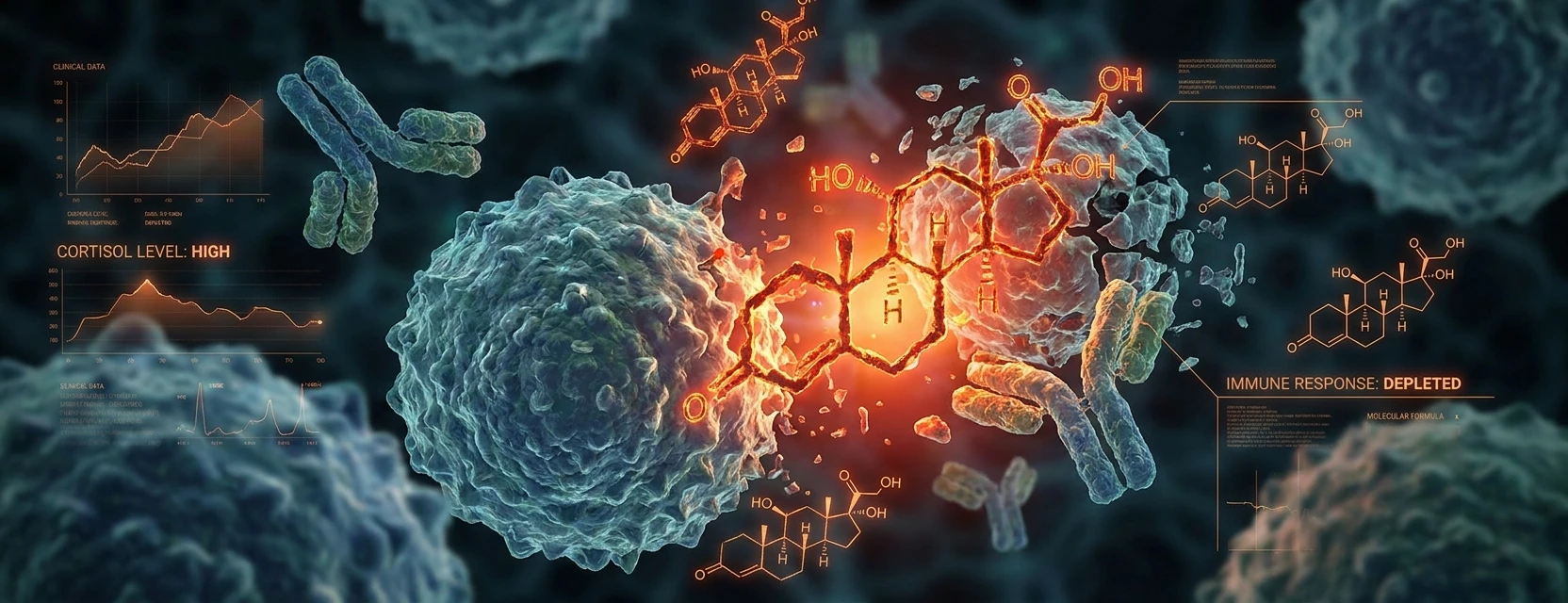
"Stress is just in your head. It'll pass. Just relax." That's The Lie. Stress leaves fingerprints in the body — measurable, mappable, addressable.
Find yours →Check what's true for you right now. This isn't a diagnosis — it's recognition.
The more boxes you checked, the more your stress system is communicating through your immune system and chronic inflammation.
Find your exact stress pattern →"Psychoneuroimmunology is no longer a fringe field. The mechanisms by which chronic stress suppresses immunity — via glucocorticoid receptor downregulation and IL-6 elevation — are established at the molecular level."
— Segerstrom & Miller, Psychological Bulletin, 2004 (meta-analysis of 293 studies)
Your body is not failing you.
It is signalling you.
The connection between immune system and chronic inflammation and chronic stress is not a coincidence — it is a biological signal your body has been sending, often for years. The Stress Fingerprint™ is how you learn to read it.
Immune System and Chronic Inflammation stress doesn't stay in one place. Your Stress Fingerprint™ maps exactly which of these systems is carrying the highest load — and in what order they broke down.
Natural killer cells are your first-line cancer and viral surveillance system. Cortisol binds glucocorticoid receptors on NK cells and directly reduces their activity and number.
Acute stress is anti-inflammatory (cortisol suppresses cytokines). Chronic stress inverts this — creating chronic low-grade inflammation (high IL-6, CRP) that is the substrate of most modern disease.
The brain's stress response directly signals immune cells via the hypothalamic-pituitary-adrenal AND the sympathetic-adrenal-medullary axes — simultaneously.
Most immune memory consolidation occurs during slow-wave sleep. Cortisol-fragmented sleep means fewer T-cell clones, weaker antibody responses, and slower healing.
DHEA (adrenal androgen) naturally counter-balances cortisol's immunosuppressive effects. Chronic stress depletes DHEA, removing this buffer.
The same inflammatory cytokines (IL-6, TNF-α) that suppress immunity also accelerate atherosclerosis — explaining why high-stress individuals face both immune and cardiac risk.
Psychoneuroimmunology has produced over 300 peer-reviewed studies demonstrating that psychological stress produces measurable, dose-dependent immune suppression. The pathways are direct: the hypothalamus signals the adrenal glands (HPA axis) and the sympathetic nervous system simultaneously, and both pathways converge on immune tissue. The result is reduced NK cell activity, altered cytokine balance, and impaired adaptive immune memory — all measurable in a blood draw.
The Fingerprint maps all 6 body systems simultaneously. If immune system and chronic inflammation is in your picture, it will appear in your dominant systems — and you'll see exactly which pattern it's forming.
The research is specific to India — and the numbers are harder to ignore than you might expect.
Recovery is not an event — it is a direction. The Stress Fingerprint™ maps where you are today and shows you the next step.
Start your recovery journey today
Map your stress pattern — free, 3 minutes. Your results connect immune system and chronic inflammation to the body system carrying the load.
The Stress Fingerprint™ maps all 6 body systems in 3 minutes — free, no login. See exactly where your stress lives and which of 8 patterns it's forming.
Take My Free Stress Fingerprint™ →3 minutes · 18 questions · No login · Free forever
💛 The Care Loop
Share this with them. You’re not sharing a link — you’re giving them a mirror. The Stress Fingerprint™ is free, 2 minutes, no login.
Stress rarely affects one system alone.
Not medical advice. This page provides educational information about the connection between chronic stress and immune system and chronic inflammation, based on peer-reviewed research. It is not a substitute for clinical diagnosis or treatment. Please consult a qualified healthcare professional for personal medical guidance.
Retake your Stress Fingerprint™ in 4 weeks to track how your body is responding to recovery.