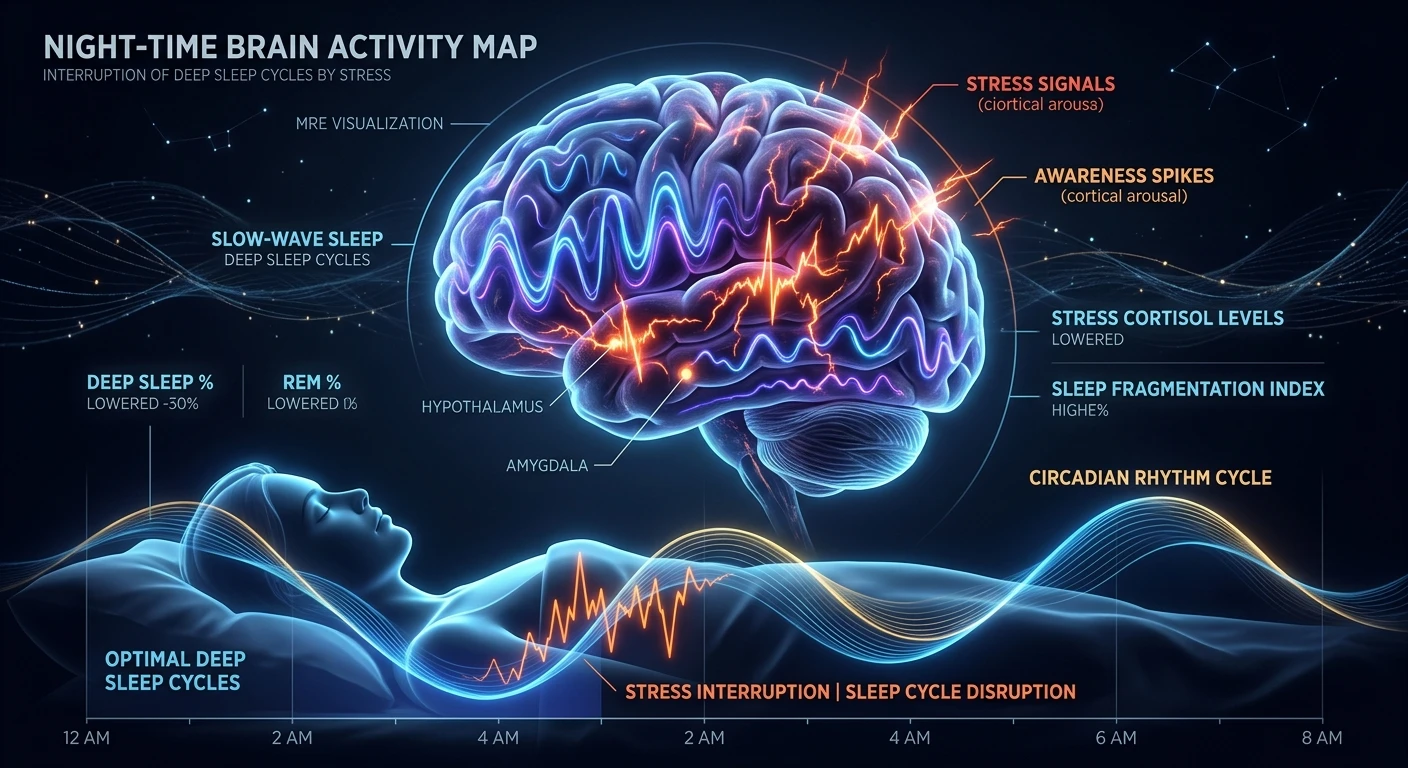
"Stress is just in your head. It'll pass. Just relax." That's The Lie. Stress leaves fingerprints in the body — measurable, mappable, addressable.
Find yours →Check what's true for you right now. This isn't a diagnosis — it's recognition.
The more boxes you checked, the more your stress system is communicating through your sleep disorders.
Find your exact stress pattern →"There is no physiological process in the body that isn't negatively affected by sleep deprivation. Stress is the #1 cause of insomnia — and insomnia is the #1 amplifier of stress. The loop is vicious."
— Matthew Walker, Why We Sleep (UC Berkeley, 2017)
Your body is not failing you.
It is signalling you.
The connection between sleep disorders and chronic stress is not a coincidence — it is a biological signal your body has been sending, often for years. The Stress Fingerprint™ is how you learn to read it.
Sleep Disorders stress doesn't stay in one place. Your Stress Fingerprint™ maps exactly which of these systems is carrying the highest load — and in what order they broke down.
Cortisol suppresses melatonin and delays sleep onset. Even when sleep occurs, elevated cortisol fragments deep sleep — so hours in bed don't equal restoration.
Memory consolidation occurs in NREM stage 3. Cortisol fragmentation prevents this — leading to next-day brain fog, poor recall, and irritability that increase stress further.
Short sleep (<6h) raises resting blood pressure by 7–15mmHg. The heart doesn't rest when you don't.
Poor sleep elevates ghrelin (hunger), suppresses leptin (satiety), and disrupts growth hormone release — driving weight gain, hormone dysregulation, and impaired recovery.
NK cells — the body's cancer surveillance system — drop by 72% after one night under 6 hours. Sleep is when your immune system does its most critical work.
Circadian disruption alters gut motility and microbiome composition. Stress-sleep cycles are a major driver of IBS, GERD, and gut dysbiosis.
The cortisol-melatonin relationship is inverse and precise. At healthy baseline, cortisol should be at its lowest at 10pm — and melatonin highest. Chronic stress inverts this: cortisol stays elevated at night, melatonin is suppressed, and the sleep system can't activate. Sleep hygiene tools (screens, timing) address the surface. The root cause — HPA dysregulation — requires a different intervention entirely.
The Fingerprint maps all 6 body systems simultaneously. If sleep disorders is in your picture, it will appear in your dominant systems — and you'll see exactly which pattern it's forming.
The research is specific to India — and the numbers are harder to ignore than you might expect.
Recovery is not an event — it is a direction. The Stress Fingerprint™ maps where you are today and shows you the next step.
Start your recovery journey today
Map your stress pattern — free, 3 minutes. Your results connect sleep disorders to the body system carrying the load.
The Stress Fingerprint™ maps all 6 body systems in 3 minutes — free, no login. See exactly where your stress lives and which of 8 patterns it's forming.
Take My Free Stress Fingerprint™ →3 minutes · 18 questions · No login · Free forever
💛 The Care Loop
Share this with them. You’re not sharing a link — you’re giving them a mirror. The Stress Fingerprint™ is free, 2 minutes, no login.
Stress rarely affects one system alone.
Not medical advice. This page provides educational information about the connection between chronic stress and sleep disorders, based on peer-reviewed research. It is not a substitute for clinical diagnosis or treatment. Please consult a qualified healthcare professional for personal medical guidance.
Retake your Stress Fingerprint™ in 4 weeks to track how your body is responding to recovery.